

CTV & Video
Understand whether video ads played on screen, with sound and in view, across connected TV and online video.
Serving an impression isn't the same as earning one. Deal Current helps advertisers, agencies, and publishers measure whether ads actually had the chance to be seen by real people—and shift spend toward the placements that deliver.
Illustrative animation. Not live measurement data.
Reaching the right person in the right context only matters if the ad actually appears on their screen. An ad can load perfectly and still never be seen—scrolled past, buried below the fold, playing in a background tab, or served to a bot.
That's why viewability is the foundation of media quality. Buyers want proof their budgets earned real opportunities to be seen, and sellers want to show the value of their inventory. Increasingly, both want to transact on viewability itself.
Stop paying full price for ads no one had a chance to see.
Identify the formats, placements, and partners that hold attention longest.
Give buyers and sellers one consistent view, reducing time spent reconciling numbers.
Keep invalid and non-human traffic out of the numbers that drive decisions.
The widely used baseline comes from the Media Rating Council (MRC) viewability guidelines. Many advertisers choose to set stricter standards of their own.
of an ad's pixels must be in view on screen for a standard display or video impression.
MRC guidelineof continuous time in view for display ads to count as viewable.
MRC guidelineof continuous play while in view for video ads to count as viewable.
MRC guideline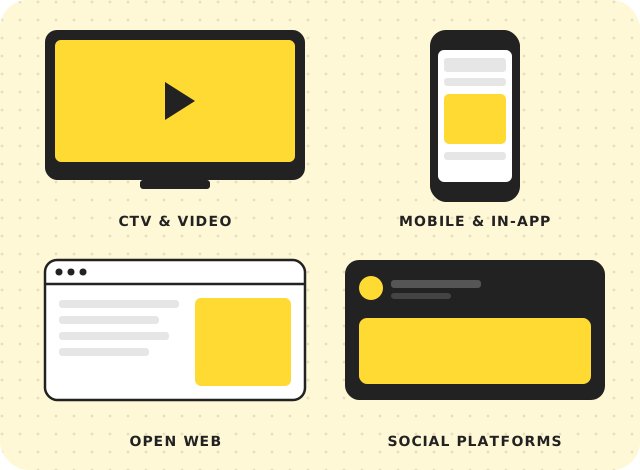
Your audience moves between devices all day. Your measurement should follow them—with consistent definitions, wherever your ads run.
Understand whether video ads played on screen, with sound and in view, across connected TV and online video.
Measure ads in mobile web and apps, where small screens and fast scrolling make viewability harder to earn.
Evaluate display and video placements across publisher sites to see which inventory is actually seen.
Bring viewability insight to social campaigns where supported by each platform's measurement partnerships.
The longer an ad stays in front of a real person, the greater its chance to make an impression. Our solutions help you see what's working and move budget accordingly—for buyers and sellers alike.
Go beyond the baseline. Define your own viewable impression—more pixels, more time, audible video—and apply it consistently across campaigns, with fast setup and clear reporting.
A viewable bot is still a bot. We pair industry-standard viewability methods with invalid traffic filtering so the numbers you optimize against reflect real people.
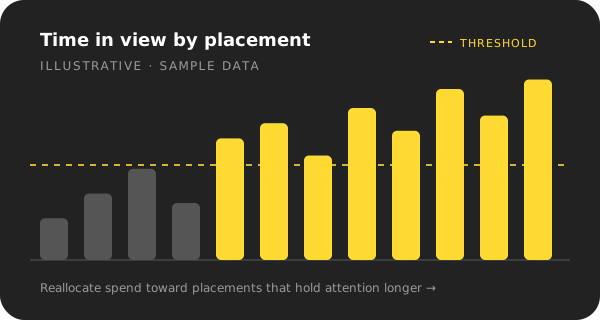
Not all viewable impressions are equal. Time-in-view and engagement signals show which placements hold attention, so you can reallocate toward the ones that leave a lasting impression.
Verify delivery quality, optimize toward viewable and attentive placements, and report with confidence.
Demonstrate the value of your inventory, package high-viewability supply, and reduce discrepancies with buyers.
Agree on goals and the viewability standard that fits your campaigns—industry baseline or your own.
Measurement is applied across your campaigns and channels using your ad server and platform integrations.
Invalid and non-human traffic is identified and separated so reporting reflects real people.
Use clear reporting to shift budget toward the formats, placements, and partners that perform.
Our team responds quickly to questions about setup, standards, and reporting—so issues get solved while campaigns are still live.
Clear definitions, documented methodology, and reporting you can share with partners. No black boxes—just numbers you can explain.
Straight answers to the questions we hear most about ad viewability.
Ad viewability describes whether a digital ad had the opportunity to be seen by a real person. An impression is considered viewable when it meets minimum standards for how much of the ad was on screen and for how long. Viewability doesn't measure whether someone actually looked at the ad, whether they were in the target audience, or how effective the ad was—and invalid or bot traffic should be excluded from viewable counts.
The commonly used baseline comes from the Media Rating Council (MRC) and IAB guidelines: for display ads, at least 50% of pixels in view for at least one continuous second; for video ads, at least 50% of pixels in view for at least two continuous seconds. Large display formats have a lower pixel threshold. Many advertisers set stricter custom standards.
Viewability rate is typically the number of viewable impressions divided by the number of measured impressions, expressed as a percentage. Measurement code tracks the ad's position on screen and how long it stays in view.
It means that 70% of the measured impressions met the viewability standard being used. The other 30% were measured but never had the required share of the ad on screen for the required time.
In viewability terms, a view generally refers to a viewable impression—an ad that met the minimum on-screen and time requirements. It's different from a served impression, which only means the ad was delivered.
Common approaches include favoring placements above the fold or near content, using formats that stay on screen longer, choosing faster-loading creative, avoiding cluttered pages, optimizing toward partners and placements with higher viewability, and filtering invalid traffic.
If an ad isn't seen, it can't influence anyone. Viewability helps buyers avoid paying for wasted impressions, helps sellers prove the value of their inventory, and gives both sides a common basis for evaluating media quality.
We work with your ad server, platforms, and partners to apply industry-standard methodologies, filter invalid traffic, and deliver reporting on viewability and time-in-view. We then help you use that data to shift budget toward better-performing placements. Specific capabilities vary by channel and integration.
No. Viewability depends on many factors—format, placement, device, page design, and user behavior—and measurement availability differs by platform. What we provide is transparent measurement and practical recommendations to help improve results over time.
Tell us about your campaigns or inventory, and we'll follow up to discuss how viewability measurement can help—usually within one business day.
Office667 Madison Ave.
New York, NY 10065

We use necessary cookies to run this site. With your permission, we'd also like to use analytics and marketing cookies. Nothing optional loads until you choose. Cookie Policy